Do You Know Your Crystal Hardnesses, Or Even What That Means?
Updated, 4/9/2026
I’ve had many conversations over the years with people wanting to know the meaning of a crystal.
Often, when I start talking about a crystal’s hardness, most people will pause and listen. But a few have cut me off with:
“I just want the meaning!”
The thing is, if you want to understand your crystals better — whether you’re drawn to them for collecting, metaphysical work, spiritual connection, or simply because you think they’re beautiful — understanding their physical properties is important too.
One of the basics is crystal hardness.
Knowing a little about hardness can help you understand how to handle and store your crystals, which ones may be suitable for jewellery, and why some stones scratch or become damaged much more easily than others.
And that brings me to a story from many years ago...
The Case of the Shrinking Sphere
Back in 1991, not long after my mum and dad opened their shop in Pyes Pa (no longer there), a young man came in looking rather puzzled and concerned.
He had previously bought a lovely Aragonite sphere and returned to the shop saying:
“My crystal has shrunk!”
The polish had deteriorated and the sphere was visibly smaller.
My dad, who was deeply knowledgeable about minerals, looked at it and asked:
“What on earth did you do to it?”
The young man proudly replied:
“I cleansed it in salt water... for seven days.”
Now, my dad — who was also an avid saltwater fisherman — paused, then smiled.
“You do know salt is corrosive, right?” he said.
From there, Dad explained that crystals and minerals have different physical and chemical properties. Some are considerably more delicate than others, and prolonged exposure to salt water is definitely not a universal method for looking after crystals.
That poor Aragonite sphere had learnt that lesson the hard way.
Or perhaps its owner had!
What Is the Mohs Scale?
Mineral hardness is commonly measured using the Mohs Scale of Mineral Hardness, developed by German mineralogist Friedrich Mohs in 1812.
The scale ranks ten reference minerals from 1 (softest) to 10 (hardest) according to their resistance to being scratched.
The important word here is scratched.
Mohs hardness does not tell us whether a mineral is safe in water, salt water, sunlight, acid or cleaning products. Those things can depend on its chemical composition, structure, porosity, cleavage, inclusions and any treatments the stone may have received.
That's an important distinction.
The Mohs Scale — A Quick Rundown
The ten reference minerals are:
1. Talc — Extremely soft and easily scratched.
2. Gypsum — Soft enough to be scratched with a fingernail. Satin Spar, commonly sold as “Selenite”, is a variety of Gypsum.
3. Calcite — A relatively soft mineral that scratches easily.
4. Fluorite — Beautiful and colourful, but comparatively delicate.
5. Apatite — Harder than Fluorite, although it still requires care.
6. Orthoclase Feldspar — A common feldspar mineral.
7. Quartz — A very common and relatively hard mineral. Amethyst, Citrine, Smoky Quartz and Rose Quartz are all varieties of Quartz.
8. Topaz — A hard mineral, although hardness doesn't necessarily mean a stone can't chip or break.
9. Corundum — The mineral family that includes Ruby and Sapphire.
10. Diamond — The hardest naturally occurring mineral on the Mohs Scale.
One of the easiest things to remember is:
A harder mineral can scratch a softer mineral.
That's why hardness becomes very useful when you're building a crystal collection.
Why Does Crystal Hardness Matter in Real Life?1. Satin Spar “Selenite” — Mohs Hardness 2
Satin Spar is beautiful, but it is also very soft.
It can scratch, chip and splinter relatively easily.
Put a piece of Satin Spar in a pouch alongside Quartz, which has a hardness of 7, and the Quartz can damage it.
This is one reason I recommend taking a little extra care when storing or transporting softer crystals.
2. Hardness Does NOT Automatically Mean “Water Safe”
This is one crystal myth worth clearing up.
You may see advice online saying that crystals above a particular Mohs hardness are safe to put in water.
Unfortunately, it isn't that simple.
The Mohs Scale measures scratch resistance, not how a mineral will chemically react with water.
Some minerals may dissolve, oxidise, become dull, lose their polish or otherwise deteriorate when exposed to water, salt or chemicals. A specimen can also contain several different minerals, meaning you can't necessarily judge the whole piece by the hardness of just one component.
So please don't use the Mohs Scale alone to decide whether your crystal should go into water.
When in doubt, keep it dry.
And I certainly wouldn't recommend soaking an unknown crystal in salt water for seven days!
My dad would probably have something to say about that.
3. Choosing Crystals for Jewellery
Hardness is useful when considering jewellery because jewellery gets knocked, rubbed and scratched during everyday life.
Softer stones such as Calcite (3) and Fluorite (4) can make beautiful jewellery, but they generally require more care than harder stones.
Where the stone is worn also matters.
A pendant is usually protected from knocks more than a ring or bracelet. Rings in particular can have a surprisingly hard life — hitting benches, doors, car handles and goodness knows what else.
And remember: hard doesn't mean unbreakable.
Hardness measures scratching. A hard mineral can still fracture or chip depending on its structure and how it is hit.
4. Store Your Crystals With a Little Thought
If you throw a collection of crystals together in a bag or box, harder minerals can scratch softer ones.
You don't need to become obsessive about it.
Simply wrapping delicate pieces, keeping particularly soft specimens separate, or using individual compartments can make a big difference.
This is also why we don't have bowls of mixed “crystal confetti” at Blissful Things.
Imagine tossing Satin Spar, Calcite and Quartz together and letting them rub against one another.
If you've been paying attention, you'll now know exactly why that makes me twitch a little!
Hardness Is Only Part of the Story
Mohs hardness is incredibly useful, but it is only one property of a mineral.
When caring for a crystal, you may also need to consider things such as:
Cleavage and fracture
Chemical composition
Porosity
Stability in water
Reaction to salt or acids
Sensitivity to sunlight or heat
Surface coatings and treatments
Other minerals contained within the specimen
Natural rocks and mineral specimens can also contain several different minerals, each with different properties.
So if you're unsure how to care for a particular crystal, ask the person you purchased it from.
After all, they should know their Mohs Scale! ;-)
Crystal Meaning Matters — But So Does Knowing Your Crystal
Understanding the physical properties of crystals doesn't take away from their beauty, meaning or magic.
I think it adds another layer to appreciating them.
Learning what a mineral actually is, how it formed, how hard it is and how best to care for it gives you a much better understanding of the piece sitting in your hand.
So yes, crystal meaning matters — but crystal knowledge matters too.
If you love your crystals, learn a little about them.
And whatever you do, please don't put your beautiful Aragonite sphere in salt water for seven days!
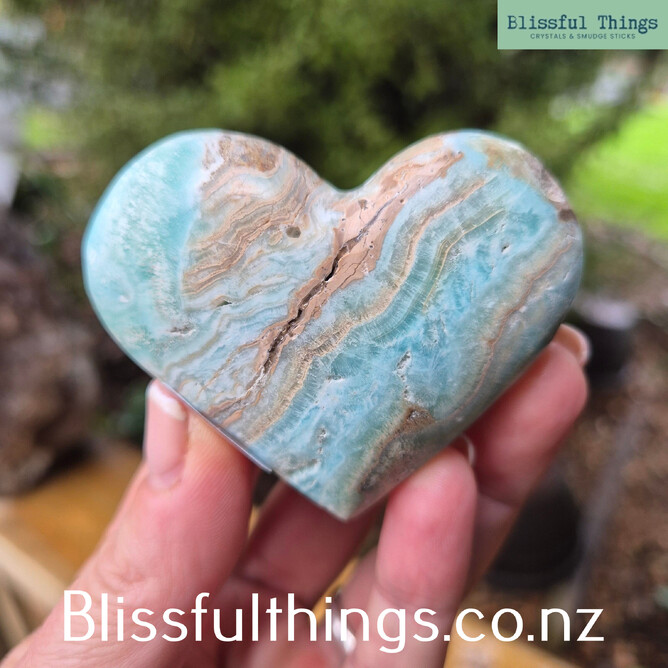
Photo: A Blue Aragonite Heart that I sincerely hope never sees salty water.
Please note: This is a general educational guide. Natural rocks and mineral specimens can contain multiple minerals and may vary in composition and durability. If you're unsure how to care for a particular specimen, seek advice before exposing it to water, salt, chemicals, heat or prolonged sunlight.
Blissful Things
Professional Crystal Enabler since ages ago!
blissfulthings.co.nz

