Lemurian Quartz: Trend or Truth?
Updated 10/10/26
Lemurian Quartz: Trend or Truth?
Oh dear, another crystal trend!
If there’s one thing I’m not, it’s someone who blindly follows the latest crystal craze. But, me being me, I had to investigate. After all, when a crystal starts attracting a lot of attention, I like to know whether there’s something genuinely interesting behind it or whether we're simply looking at clever marketing.
And Lemurian Quartz certainly has a story to tell!
So, What Exactly Is Lemurian Quartz?
First things first. Lemurian Quartz is a trade name, not a scientifically recognised mineral variety.
Mineralogically speaking, it's quartz. Good old silicon dioxide (SiO₂), the same mineral that makes up Clear Quartz, Smoky Quartz, Amethyst, and many other familiar favourites.
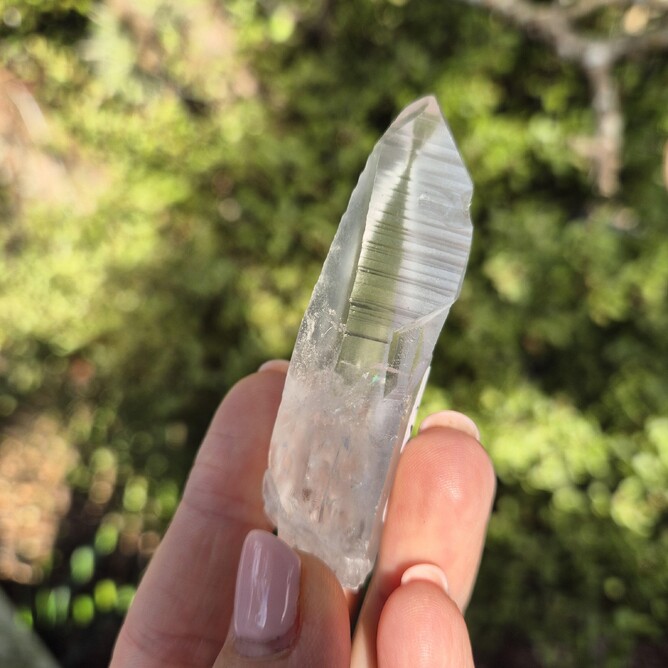
What makes Lemurian Quartz distinctive is its appearance, particularly the horizontal striations that run across some of its crystal faces.
These little ridges are often referred to as Lemurian lines or barcodes in metaphysical circles.
If you can't quite see them, try gently running your fingernail along the side of the crystal. You may feel a series of fine ridges.
These markings are natural growth features, not mysterious inscriptions. They develop through geological processes as the quartz crystal grows.
And here's where things get interesting.
These striations aren't exclusive to Lemurian Quartz. Similar growth markings can occur on quartz crystals from numerous locations around the world.
So, while the lines may be a distinctive feature of a crystal being sold as Lemurian Quartz, they don't automatically make it a Lemurian.
Where Does Lemurian Quartz Come From?
Traditionally, Lemurian Quartz has been associated with Brazil, particularly the state of Minas Gerais. However, it's certainly not limited to Brazil!
Today, crystals marketed as Lemurian Quartz are also coming out of Colombia and other locations around the world.
In fact, I have a quartz specimen in my own personal collection from the Mount Everest region, displaying those distinctive horizontal striations associated with Lemurian Quartz.
And that's something worth remembering.
These natural growth markings aren't exclusive to one particular country or deposit. Similar formations can occur wherever the right geological conditions exist.
The important distinction is that Lemurian Quartz is a trade name, not an officially recognised mineral classification. There isn't a universally accepted geological definition determining which quartz crystals qualify.
So, does a Lemurian Quartz crystal have to come from Brazil?
Absolutely not!
However, Brazilian specimens are traditionally associated with the name, and different sellers may use the term in slightly different ways.
My advice? Ask about the crystal's origin, appreciate its natural features, and don't get too caught up in the marketing.
After all, nature doesn't recognise trade names!
Is Lemurian Quartz Always Clear?
Not at all!
While Clear Lemurian Quartz is probably the most familiar, you may also encounter:
Smoky Lemurian Quartz: Quartz with a natural smoky colouring, ranging from pale grey to deeper brown.
Tangerine Lemurian Quartz: Quartz displaying orange to reddish colouring, commonly associated with iron oxide staining or coatings.
Pink or other coloured Lemurian Quartz: Names sometimes used in the crystal trade, although their definitions and origins can vary considerably.
Some varieties can be harder to source than others, but rarity should always be assessed on the actual specimen rather than the marketing name alone.
The Legend of Lemuria
Now, this is where geology takes a back seat and the metaphysical stories begin!
The name Lemurian comes from Lemuria, a hypothetical lost continent proposed in the 19th century and later incorporated into various esoteric teachings.
In modern crystal folklore, Lemuria is often described as an ancient civilisation inhabited by spiritually advanced beings.
According to the story, these beings encoded their wisdom and knowledge into quartz crystals before their civilisation disappeared.
The horizontal ridges supposedly contain this information, which can be accessed through meditation or spiritual practices.
It's certainly a fascinating story!
From a scientific and archaeological perspective, there is currently no accepted evidence supporting the existence of the advanced Lemurian civilisation described in these traditions.
However, the original idea of Lemuria began as a scientific hypothesis, and theories about lost lands, submerged continents and ancient civilisations have continued to attract interest over the years.
Of course, when looking into these theories, it's important to consider where researchers have sourced their information, what evidence they're relying on, and whether their conclusions are supported or remain speculative.
But that's another blog for another time!
For now, whether you enjoy the mythology, believe there's more to the story, or simply appreciate the crystals themselves, that's entirely up to you.
What About the Metaphysical Properties?
Now we're getting into an area that many crystal lovers enjoy exploring.
In metaphysical traditions, Quartz is often described as an energy amplifier. Lemurian Quartz is particularly associated with spiritual awareness, intuition, meditation, and accessing higher guidance.
Some practitioners believe the horizontal ridges encourage reflection, connection, and spiritual exploration.
Lemurian Quartz is also commonly associated with the Crown Chakra and, in some traditions, the Third Eye and Throat Chakras.
Of course, these are spiritual interpretations rather than scientifically demonstrated properties.
Personally, I think the natural shape of many Lemurian Quartz crystals is one of their most interesting features.
Their elongated, sometimes laser-like points make them appealing to people who practise directional energy work.
Crystal healers, Reiki practitioners, and those who enjoy crystal layouts often favour these formations.
Over the years, I've also sold quite a few Lemurian Quartz points and pendants for use as pendulums. Their elongated shape can make them particularly appealing for this purpose.
But here's something I always like to remind people.
You don't need to purchase an expensive Lemurian Quartz crystal to enjoy working with quartz.
A beautiful piece of ordinary Clear Quartz may be just as suitable for your personal practice.
It's about what appeals to you, how you choose to use it, and, importantly, what fits your budget.
Is Lemurian Quartz Worth the Money?
That depends on what you're purchasing.
A beautifully formed quartz crystal with excellent clarity, attractive striations, minimal damage and good provenance may genuinely command a higher price.
If a specimen has chips or damage, this should generally be reflected in its price. After all, condition is an important consideration when determining the commercial value of a mineral specimen.
However, from a metaphysical perspective, a chip or two doesn't necessarily matter.
A crystal doesn't suddenly lose its personal or spiritual significance simply because it has a little damage.
If you love a particular crystal, and it fits within your budget, that's what matters.
However, if the price is based primarily on claims of ancient Lemurian wisdom or extraordinary spiritual powers, I'd encourage you to look a little closer.
When purchasing any crystal, consider its quality, condition, size, appearance, origin and how much you personally enjoy it.
A trade name alone shouldn't determine its value.
So, Lemurian Quartz: Trend or Truth?
Well, perhaps a little of both!
The crystal itself is absolutely real. The horizontal striations are real, and some specimens are genuinely beautiful examples of natural quartz growth.
The name, however, is a commercial and metaphysical designation rather than a separate mineral classification.
And the ancient Lemurian civilisation?
Well, you just never know. ;-)
Does that make Lemurian Quartz any less beautiful?
Not in my books!
I think we can appreciate these crystals for their natural formation, geological history and appearance without needing to accept every extraordinary claim attached to them.
If you feel drawn to Lemurian Quartz, wonderful. Enjoy it!
And if you've already got a lovely piece of ordinary quartz sitting at home, don't feel you're missing out.
Sometimes a crystal is simply beautiful because nature made it that way.
Happy crystal exploring!
Kristy
Blissful Things NZ
Professional Crystal Enabler Since 1986
Shop Lemurian Quartz
Interested in adding a Lemurian Quartz crystal to your collection?
Explore our selection of Lemurian Quartz crystals, points and pendants available through Blissful Things NZ.
Visit Blissful Things NZ
Please note: Metaphysical crystal properties are based on traditional and contemporary spiritual beliefs and have not been scientifically established.
To Shop Lemurian Quartz, here is the link. https://blissfulthings.rocketspark.co.nz/shop/#search=lemurian%20quartz

