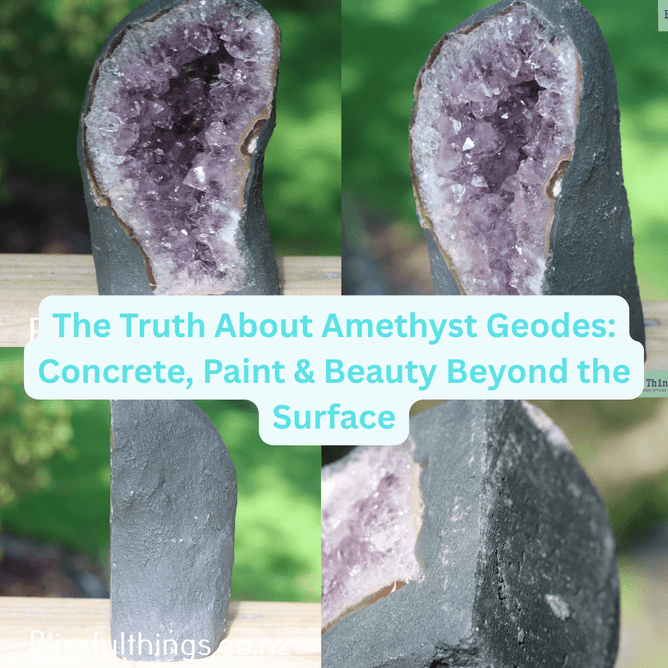
The Truth About Amethyst Geodes: Concrete, Paint & Beauty Beyond the Surface
If you’ve ever been mesmerised by an Amethyst geode—those towering crystal cathedrals or deep sparkling caves—you’re not alone. These treasures from the earth have captured hearts for generations. But did you know many of the geodes from South America, particularly Brazil and Uruguay, have had a little help along the way to look their best and survive the journey to you?
Let’s dive into the why, how, and what it really means.
Why Concrete?
Here’s something many people don’t realise: some Amethyst geodes—especially the large cathedrals—are surprisingly fragile. The outer shell can be as thin and brittle as an eggshell. Once these geodes are extracted from basalt-rich mountain walls, they often need support to remain stable—especially after being cut with industrial diamond saws.
That’s where concrete comes in.
Concrete is used to stabilise the base and back of many geodes. This ensures they don’t crack, crumble, or collapse during cutting, shipping, or even while sitting in your home. Imagine the heartbreak if your geode fell over and shattered—it’s not just about looks, it’s about long-term preservation. I’d be gutted if my geode broke—so personally, I’m very grateful for this extra care.
Concrete also allows them to stand up safely, which helps them display beautifully in your space.
Why Paint?
Ever noticed a green or grey colour on the back of a geode? That’s usually paint. Traditionally, a green coating has been used for decades to cover the raw matrix and to give the geode a finished, uniform look. Sometimes it's painted over cement, sometimes over natural basalt. This doesn't affect the crystal energy—it's purely aesthetic and protective.
The green colour originally mimicked celadonite, a naturally occurring mineral that lines the gas pockets where Amethyst grows. In fact, in high-quality pieces, celadonite might actually still be present—and some artisans mix it with concrete to blend the look even further.
It’s Not a Secret – It’s Industry Standard
This isn’t some hidden trick. These methods are a long-accepted, standard part of the crystal trade, especially with large geodes. From miners to cutters, many of the people working on these pieces are second, third, even fourth generation artisans who take pride in their work. Stabilising geodes reduces waste, provides employment, and ensures more pieces can make it into the world for us to enjoy.
Without this, many geodes wouldn’t make it out intact. And the ones that did would be far more expensive and far fewer in number.
It Doesn’t Change the Energy
I often hear people say they feel “put off” once they hear a geode has concrete or paint on the back. But metaphysically, it doesn’t change a thing. If you were drawn to that geode, if it made you pause, feel something, or light up—that’s your answer. Trust how you felt when you first saw it.
Don’t let the idea of some cement put you off from something magical. After all, humans have been working with and modifying crystals for centuries—from carvings to polishing to tumbling.
Choosing Your Geode
When shopping for an Amethyst geode or cathedral, yes—there may be some concrete involved. And yes—there might be paint. But that’s not what determines the value.
What you’re really paying for is:
Colour intensity (darker purples are generally more valuable)
Clarity and crystal quality
Unique features like:
Agate banding
Calcite or goethite inclusions
Rainbows
Druzy coatings
Smoky or clear quartz blends
Flower formations
And let me tell you, in Uruguay alone, there are over 35 different grades and shades of Amethyst! (And as I type, that information has most likely been changed as the gem industry is constantly changing.) So take your time. Look closely. Let yourself fall in love.
I’ve loved Amethyst geodes ever since I spotted my first one as a kid at Wilderness Gems (old crystal shop in New Zealand). They’ve been a source of calm, awe, and joy ever since. Now, getting to share them in my shop is a dream come true.
But with that comes a responsibility to inform. Because when you know the backstory of these beautiful formations, it only deepens your appreciation.
So next time you meet a geode—whether it’s for your home, your healing space, or your heart—remember that a little concrete or colour on the back doesn’t take away its magic. In fact, it’s probably helped protect it so you could find each other.
With crystal kindness,
Kristy
💜 Blissful Things
www.blissfulthings.co.nz
For more info on how Geodes are Formed Here is another Blog below. To shop Geodes, there is also another link below.

