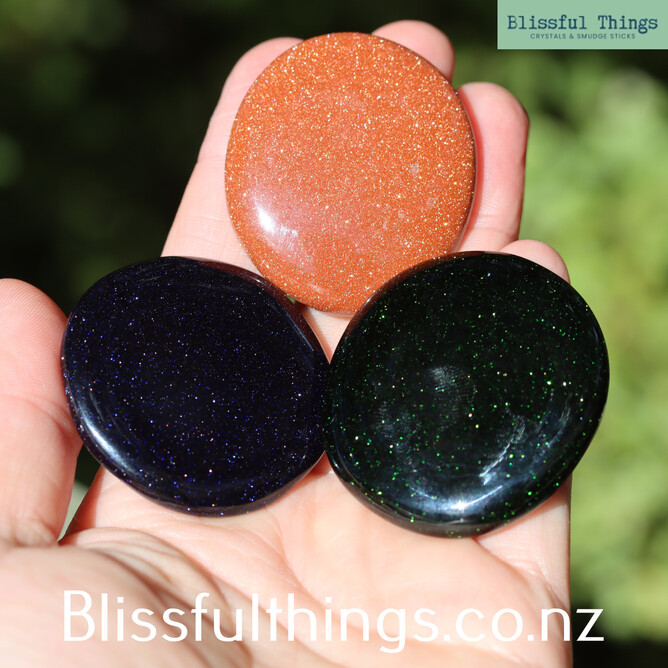
Goldstone – The Sparkling "Stone of Ambition"
Goldstone has always held a special place in my heart. As a child, I was mesmerised by its twinkling surface that looked just like gold dust. Hypnotic and magical, it quickly became one of my favourites.
Yes, it’s man-made – but interestingly, Goldstone has been embraced by the lapidary world and crystal enthusiasts alike. Back in the day, obtaining material in New Zealand was no small feat. Collectors would import the raw material from overseas, then cut and polish it here. Most of us were familiar with the classic golden-brown variety, but blues and greens were far rarer. I was lucky enough to score three pieces from an old collection my father acquired – including a green one, which I had never seen before!
Over the years, as technology advanced and production spread, Goldstone became easier to find. I’ve been calling it “Goldstone” for over 40 years (so don’t try to correct me 😉), but you may also hear it called Sandstone, Aventurine Glass, Stellaria, Gold Star Glass, Monkstone, or Monk’s Gold.
A Story of Accidental Discovery
The origins of Goldstone are wrapped in legend. The most popular story claims it was created by accident when Venetian monks in the 1600s dropped copper filings into molten glass. When the glass cooled, it sparkled with tiny copper crystals. The material was named avventurina, from the Italian word for “by chance” or “mishap.”
Although the exact date of discovery varies depending on who you ask (some say as early as the 1200s), what’s clear is that it became a carefully guarded secret of Murano glassmakers. Eventually, China acquired the knowledge, and today most Goldstone is produced there. Along the way, myths developed – I’ve even had people tell me Tibetan monks made it, which is likely just a story passed along through sellers to make it sound more mystical.
How It’s Made
The process of creating Goldstone is more complex than it first appears.
Glass is heated until molten.
Copper oxide granules are added and dissolve.
As the mixture cools, copper forms tiny crystals.
Light reflecting off these crystals creates the sparkling effect we all love.
The colour depends on what’s added to the glass:
Brown/Gold: Clear glass with copper inclusions.
Blue: Cobalt replaces copper.
Green: Chromium replaces copper.
Blue Goldstone tends to sparkle the most, while the golden-brown variety carries a more earthy glow.
Goldstone in the Crystal World
Despite being man-made, Goldstone has stood the test of time and is deeply valued in the metaphysical world. Known as the “Stone of Ambition,” it’s said to:
Boost confidence and motivation, encourage a positive attitude, support vitality and energy flow through its copper content. Inspire courage and drive
Whether you see it as a beautiful glass creation or a crystal with uplifting energy, Goldstone continues to capture imaginations – just as it did mine when I first laid eyes on it as a child.
To see what we have in Goldstone, Here is the Link: To View Goldstone, Click Here.

