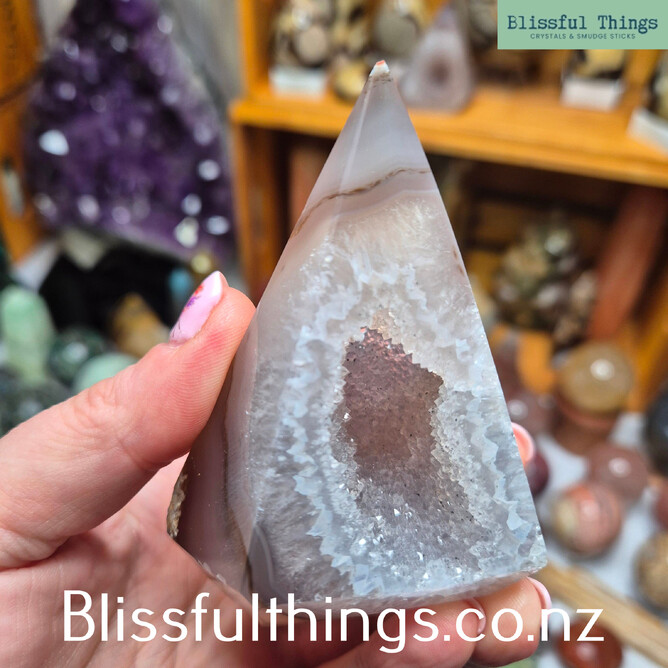
Agate – A Deep Dive into Nature’s Banded Beauty
Agate is one of those crystals that quietly steals the show. A captivating variety of chalcedony (a microcrystalline form of quartz), Agate is loved for its swirling bands, earthy colours, and amazing durability. This is a general guide—there are so many different types of Agate that you could spend a lifetime collecting and still be surprised.
Science & Structure
Scientifically, Agate is a silica mineral that forms when silica-rich water slowly fills cavities in volcanic rock. Over time, layers of silica build up, creating those trademark stripes and ripples. Because it’s made of tiny interlocking crystals, Agate is classed as cryptocrystalline quartz, giving it a hardness of 6.5–7 on the Mohs scale. That makes it sturdy enough for jewellery, home décor, and even historical tools.
Agate often keeps good company. You’ll sometimes find it alongside clear quartz, amethyst, or other chalcedony relatives like jasper and carnelian. Some specimens show pockets of sparkling druzy quartz or a beautiful mix of Agate and Jasper that collectors adore.
Colours & Treatments
Natural Agate comes in just about every shade: soft greys, mossy greens, warm browns, fiery reds, and even delicate blues. Because it takes dye well, some pieces on the market are colour-enhanced with natural or synthetic dyes and heat treatments to bring out vivid blues, pinks, or purples. Reputable sellers do their best to disclose this, but a little colour magic doesn’t change the stone’s core energy.
Agate in History
Agate has fascinated humans for thousands of years:
Ancient Egypt: Used for protective amulets and seals, believed to guard against storms and lightning.
Roman Times: Craftspeople carved Agate into signet rings and cameos, prized for its hardness and beauty.
Middle Ages: European healers ground Agate into powder, mixing it into potions for good health and strength. (Please do not use in this application as we now know more about crystals and you could get sick doing this)
Modern-Day Uses
Today Agate still finds its way into jewellery, polished slices for coasters, and even industrial applications thanks to its durability. Many Kiwi rock hounds cut and polish local Agate for pendants and cabochons. A simple polished palm stone or a raw slab on a shelf brings both natural art and calming energy to any space.
Metaphysical Magic
On the spiritual side, Agate is known as a stone of grounding and balance. Many feel it helps stabilise emotions, enhance mental clarity, and create a sense of safety. It’s often called a stone of inner strength, offering gentle protection and promoting harmony in relationships. Because of its slow, steady vibration, Agate is perfect for meditation or for keeping in a busy home or workspace.
Agate in Aotearoa
You don’t have to travel far to find beautiful Agate. Here in New Zealand you can discover storm agate—sometimes called storm jasper. Down south, collectors seek out Agates in places like Mount Somers and Birdling Flats (join a local gem club if you’re heading out, as they know the best spots and can keep you safe, not to mention you need permission if going into private land). A good storm can reveal fresh treasures along riverbeds and beaches.
Shapes and Collecting Tips
Agate comes as nodules, geodes, and banded slices. Polished spheres give a gentle, even energy, while natural chunks feel more earthy and grounding. Because of its hardness, Agate polishes beautifully—remember it can still scratch softer stones like calcite or selenite if stored together.
Bringing Agate Into Your Life
Whether you choose a natural grey-banded slice, a vivid dyed teal pendant, or a piece of local storm agate, each carries millions of years of Earth history. Place Agate in the home for a calm atmosphere, use it in crystal grids for stability, or carry a small tumbled stone in your pocket as a daily grounding companion.

