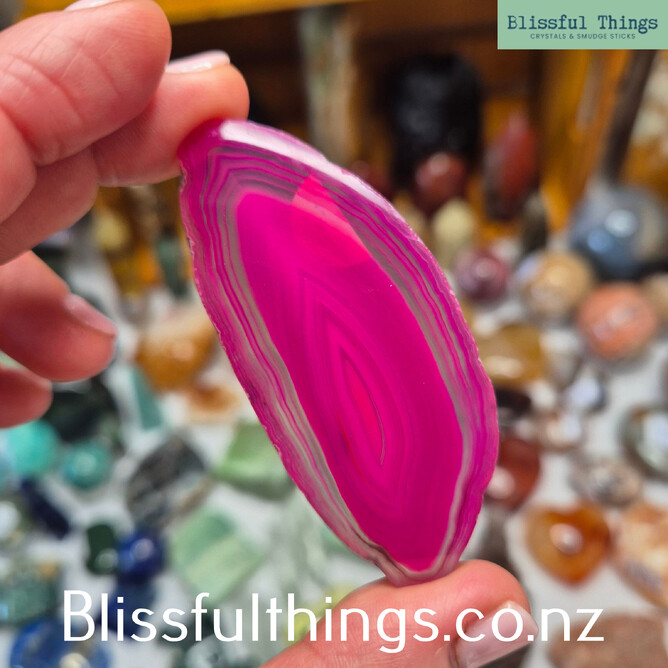
Dyed Agate - Colour, Creativity, and the Art of Enhancement
Agate, a captivating variety of chalcedony, is prized for its wide range of colours and intricate banding patterns. Scientifically, Agate is a silica mineral known for its durability and striking appearance, formed through the slow deposition of silica in volcanic rocks.
Metaphysically, Agate is renowned for its grounding and balancing properties, often used to stabilise emotions and enhance mental clarity. It is believed to offer protection and promote a sense of security, making it a popular choice for those seeking harmony and emotional resilience.
While Agate naturally appears in earthy tones — creams, browns, greys, and soft blues — sometimes humans can’t resist adding a little extra flair. That’s where Dyed Agate comes in.
What is Dyed Agate?
Dyed Agate is natural Agate that has been treated with colour-enhancing dyes to highlight its natural banding and patterns. These dyes can create vivid blues, purples, pinks, greens, and other bright hues that would rarely occur naturally.
Because Agate is porous by nature, it absorbs dye very easily, allowing the colour to settle beautifully into the banded layers — often creating eye-catching contrasts that make each slice look like a work of modern art.
Love it or hate it, Dyed Agate has a magnetic appeal — especially when light passes through a translucent slice, revealing brilliant tones that glow like stained glass. Many people are drawn to its cheerfulness and intensity, seeing it as a bridge between natural beauty and human creativity.
How Agate is Dyed
The process of dyeing Agate has been refined over time, but it usually follows a few basic steps:
Cleaning and Preparation: The raw Agate is soaked in a solution to remove surface impurities.
Dye Bath: The stone is immersed in a chemical dye bath. The type of dye and temperature determine the final colour.
Heat Treatment: Gentle heating helps the dye penetrate deeper into the stone’s structure.
Finishing: The Agate is rinsed, dried, and polished to reveal its enhanced colour and natural banding.
This enhancement doesn’t change the stone’s natural composition — it simply emphasises its existing beauty.
However, Dyed Agate can fade over time if exposed to strong sunlight for long periods, especially colours like pink and blue. To preserve its vibrancy, it’s best to display your Dyed Agate away from direct UV light or use it indoors where it can shine safely.
A Long History of Colour Enhancement
Humans have been tinkering with the colours of gemstones for thousands of years. Even in ancient times, craftspeople discovered that heating or dyeing stones could enhance their natural beauty.
From the Romans dyeing Agate with plant extracts to today’s use of chemical dyes, this practice reflects our long-standing desire to celebrate and amplify what nature has already created.
It’s a reminder that both nature and human creativity play a role in how we experience beauty — a collaboration that continues to evolve through time.
Metaphysical Perspective on Dyed Agate
Energetically, Dyed Agate still carries the core metaphysical properties of natural Agate — grounding, protection, and emotional balance.
The added colours can also influence how the energy feels:
Blue Dyed Agate is associated with calm communication and soothing energy.
Pink Dyed Agate radiates warmth, compassion, and heart energy.
Green Dyed Agate is linked with renewal, abundance, and growth.
Purple Dyed Agate inspires intuition and spiritual awareness.
So while the colour may be human-enhanced, the energy of Agate — steady, grounding, and harmonising — remains the same.
Dyed Agate at Blissful Things
Here at Blissful Things, we appreciate both natural and dyed Agate for their unique appeal. Whether you’re drawn to the soft, natural tones of earth-mined Agate or the dazzling hues of a colour-treated slice, each piece brings beauty and energy in its own way.
Dyed Agate is especially popular for decorative displays, jewellery, and spiritual use where colour energy plays a role. Its vibrant tones can uplift a room, spark creativity, and remind us that beauty can be both natural and enhanced — and that’s perfectly okay.

