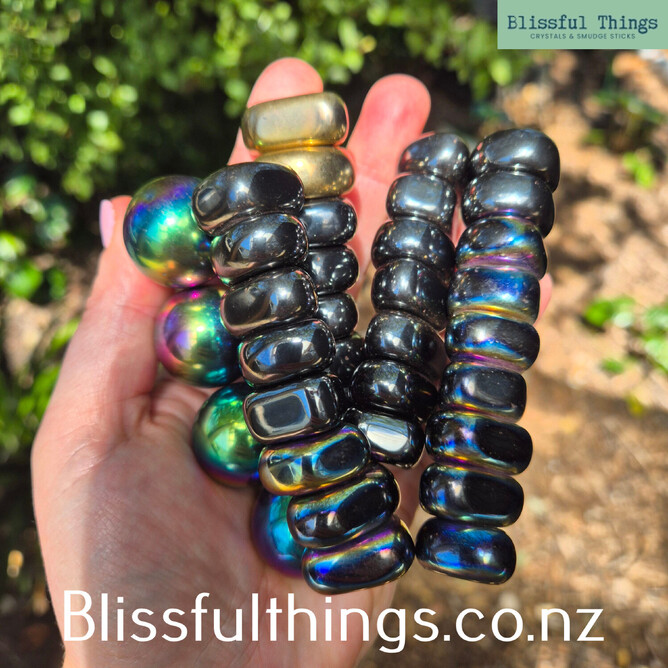
🧲 Magnetic Hematite — What It Is (and What It Isn’t)
Magnetic Hematite has become a popular item in the crystal world — shiny, fun, and fascinating to play with! But there’s a lot of confusion about what it actually is. Let’s clear things up and explore the differences between Magnetic Hematite, Magnetite, Hematite, and Lodestone (or “Lodalite”).
⚙️ What Magnetic Hematite Really Is
Magnetic Hematite may look like natural Hematite, but it’s man-made.
It’s created by heating iron oxide to a very high temperature and introducing strong magnets while the material is still hot. This process gives the finished stone its magnetic qualities — something natural Hematite or Magnetite does not have.
Some pieces are also coated in colours such as gold, silver, rainbow, or gunmetal for a decorative finish.
Although man-made, Magnetic Hematite is very popular for games, fidgeting, crafts, and energy work. It’s also used in grounding or protection practices — but it’s important to remember that it’s not naturally magnetic.
🪨 Magnetite — Not Magnetic
Some people mistakenly call Magnetic Hematite “Magnetite.”
Magnetite is a natural iron oxide mineral, but despite its name, it is not magnetic in the same way people often think. It has a metallic look similar to Hematite, but it does not naturally attract magnets like Magnetic Hematite does.
⚫ Natural Hematite — What It Really Is
Natural Hematite is another form of iron oxide (Fe₂O₃) and is also not magnetic.
It’s heavy, metallic-looking, and often used in grounding and balancing practices to connect your energy to the Earth.
Because of its similar appearance, Hematite can be mistaken for Magnetic Hematite — but a simple magnet test will show the difference. Natural Hematite won’t stick.
🌌 Lodalite / Lodestone Confusion
Another source of confusion comes from the name Lodalite. Some sellers mistakenly call Magnetic Hematite “Lodalite,” but they are completely different:
Lodalite is a type of inclusion Quartz with scenic or mossy-looking patterns inside clear quartz. It is not magnetic.
Lodestone, on the other hand, is naturally magnetic because it is a naturally magnetised form of iron oxide.
To simplify:
Magnetic Hematite = Man-made, artificially magnetic.
Magnetite / Hematite = Natural, not magnetic.
Lodalite = Natural quartz with inclusions, not magnetic.
Lodestone = Naturally magnetic mineral.
🎨 Coated Magnetic Hematite
Magnetic Hematite can also be coated in colours like gold, silver, or rainbow for decoration. These coatings do not affect the magnetism of the stone.
⚠️ Important Safety Information
Thinking this would be great for the kids or grandkids? Hold that thought for a moment.
These pieces are very strong magnets and must be handled with care:
Choking hazard: Small magnets can cause serious illness or injury if swallowed or inhaled.
Not suitable for children under 5, or anyone who may put objects in their mouth.
Adult supervision recommended for young children.
Keep out of reach of young children and animals.
Store safely when not in use.
Magnetic Hematite may look fun, but safety always comes first!
✨ In Summary
Magnetic Hematite is man-made, but still fascinating, shiny, and fun. Remember:
It is not natural Hematite or Magnetite.
Magnetite and Hematite are natural, but not magnetic.
Lodalite is natural quartz with inclusions — not magnetic.
Lodestone is naturally magnetic.
Perfect for collectors, science enthusiasts, or anyone who loves a fun magnetic toy — just handle safely!

