Can AI Really Identify Crystals? Or Is a Human Eye Still Best?
For some time now, there have been apps designed to identify just about everything — plants, insects, gemstones, you name it. There always seems to be something to help. Most of these tools are now powered by AI, and of course, there’s usually an option to upgrade, go ad-free, or pay for extra features.
And then there’s ChatGPT. One app that can do many things.
AI has undoubtedly come a long way — but does it really cut the mustard when it comes to identifying crystals? Is it worth paying for an app? What’s the best one?
Or is asking a real human with experience still the better option?
With over 40 years of hands-on crystal experience, here’s my honest take.
I’ve written similar blogs in the past, but over the last week I’ve done a bit of deep diving and really sat with this topic again. Let’s see if I land at the same conclusion.
Putting AI to the Test
I’ve tried gemstone identification apps before, and to be very honest, they’re hit and miss. There are just too many variables.
Not wanting to clutter my phone with yet another app, I decided to test ChatGPT instead. Now don’t get me wrong — I actually use ChatGPT a lot. It helps me create content, especially as I’m very dyslexic. Even then, I still re-read everything carefully to make sure the tone and context are right… and I still miss things. If you’re a spelling picker-upperer, you’ve probably already spotted a few on this very website — and that’s okay 😉
Anyway, back to identifying rocks.
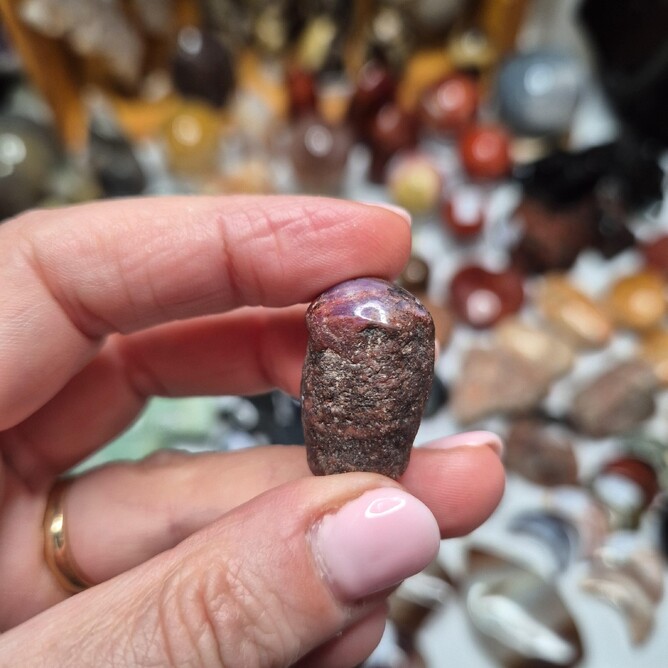
I uploaded a photo (the one shown above). I already knew exactly what the stone was, but ChatGPT told me this:
“From what I can see, it’s likely Garnet.”
It then went on to explain why garnet fits, listing six indicators, suggesting a specific type, adding metaphysical associations, and finally giving a value estimate — roughly $5–$25 USD or $10–$40 NZD, along with commentary about market quality and demand.
And that’s where I stopped.
Reading Between the Lines
Here’s the important part:
AI responses are very polished. They sound confident. But you need to read between the lines.
“From what I can see” is doing a lot of work there.
That’s not a 100% identification — it’s an educated guess. And if the ID is wrong, then everything that follows (including value) is also off.
Those six “fits” ChatGPT listed? They could easily apply to several other deep red, wine-coloured stones. The metaphysical section? Well, metaphysical meanings are fluid, personal, and open to interpretation — so I’ll give AI a free pass there.
But the value? If the stone isn’t what you think it is, then that pricing is basically pulling numbers from thin air.
The stone I uploaded was not garnet.
It was actually a star ruby.
Not especially a high value one — something like this would currently retail around $15–$18, depending on many factors. And if you know the gemstone market, you know how much variables like clarity, origin, treatment, and demand can change things.
So… Is AI Useless?
Honestly? No.
ChatGPT gave it a good crack. Many humans would have guessed garnet too. So it wasn’t terrible — it just wasn’t definitive.
And over time, AI will improve. But AI can’t:
hold a crystal
feel its weight or texture
tilt it in natural light
see subtle surface features
or compare it instinctively to hundreds of stones it’s handled before
It also comes down to how we use AI. Instead of saying, “That’s what it said, so it must be garnet,” we should treat it as one piece of information, not the final word.
Remember — ChatGPT didn’t say “This is garnet.”
It said, “From what I can see.”
That distinction matters.
Now Let’s Talk About Humans
We’re lucky — it’s never been easier to take photos. And I’m always grateful when friends, family, or customers come to me first asking, “What is this stone?”
But here’s the thing:
A crystal photo is only as good as the photo itself.
Lighting, background colour, shadows, camera quality — all of these can completely change how a stone appears. A dark photo can hide clarity. A coloured background can shift tone. Reflections can make quartz look like calcite, or vice versa.
If you’re emailing or messaging someone for help, taking a little extra care with the photo can make a huge difference.
Even then, it can still be tricky.
I can’t tell you how many times I’ve seen posts on Reddit, Facebook, or Instagram asking for an ID — and there are ten different answers underneath. Just the other day, someone posted an egg-shaped stone. The replies included:
Fire Quartz
Rutilated Quartz
Hematoid Rose Quartz
Pink Calcite with brown inclusions
“Two stones glued together”
In reality, the photo was just too dark. It was probably one of those suggestions — but without proper light, and without handling it, it’s guesswork.
Quartz and calcite, for example, can feel very different — but you can’t feel a photo.
Why Experience Still Matters
Nothing beats an experienced eye and hands-on knowledge.
When you can:
hold a crystal
turn it in the light
feel its temperature and texture
look through a jeweller’s loupe
…that’s where real identification happens.
If you’re new to collecting, experience builds over time. When you buy a crystal and don’t know its name, ask the seller to write it down. Trusted sellers, gem and mineral clubs, and shows are fantastic learning spaces.
And remember — everyone learns at their own pace.
Even experts get it wrong sometimes. I’ve seen highly trained geologists, absolute legends in their field, look at a stone like Zoisite and not recognise it. Expertise often depends on what area you work in.
If Stephen Hawking could get things wrong occasionally, I think we can forgive both AI and humans for not being perfect all the time 😉
So What’s the Answer?
A bit of AI is okay.
Photos can help — but they’re not foolproof.
Nothing beats holding a crystal in your hands.
Using both technology and human experience together is often the best approach. Compare images, read information, ask questions — and most importantly, trust your curiosity.
At the end of the day, the most important thing is this:
✨ You love what you have. ✨
And that, more than any label, really matters.

