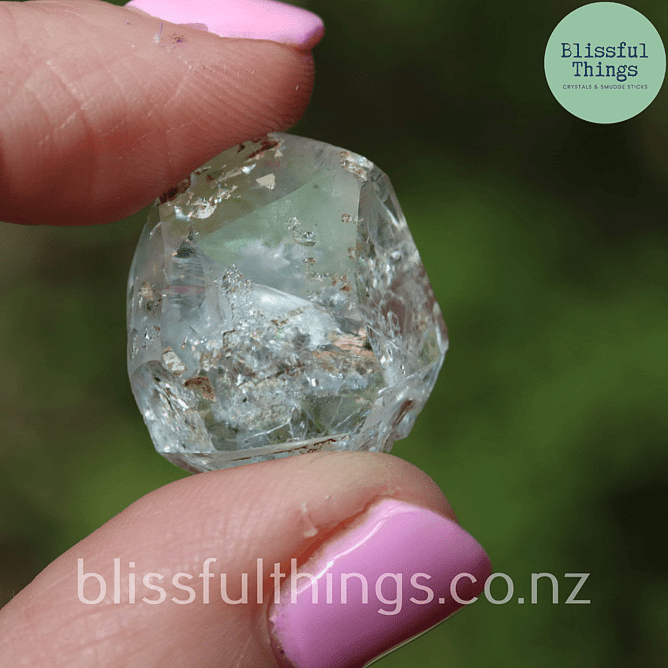
Herkimer Diamonds: What Makes Them Special?
One of the most common questions I hear is:
"Why is this Herkimer Diamond more expensive than other double-terminated quartz crystals I've seen?"
It's a great question, and the answer lies in understanding what a Herkimer Diamond actually is.
What Is a True Herkimer Diamond?
Despite the name, a Herkimer Diamond is not a diamond at all. It is a naturally double-terminated quartz crystal found in Herkimer County, New York, USA.
The name "Herkimer Diamond" refers not only to the crystal's appearance but also to its locality. In mineral collecting, where a specimen comes from can be just as important as what it looks like.
This is where some confusion can arise.
When Is a Herkimer Not a Herkimer?
Over the years, beautiful double-terminated quartz crystals have been discovered in many parts of the world, including Pakistan, Brazil, Namibia, Afghanistan, Tasmania and parts of Africa.
Many of these crystals closely resemble Herkimer Diamonds. Some are exceptionally clear, naturally double terminated and highly lustrous.
Because they look so similar, they are sometimes sold as "Herkimer Diamonds" even though they do not come from Herkimer County.
Technically speaking, these crystals are better described as double-terminated quartz.
You may also see terms such as:
Herkimer-Type Quartz
Herkimer-Like Quartz
Herkimer Style Quartz
Herkimer Diamond Quartz from Pakistan
Herkimer Diamond Quartz from Namibia
Personally, I think these descriptions can be quite helpful when the locality is clearly disclosed. They acknowledge that the crystal resembles a Herkimer while also being transparent about where it was actually found.
For example, "Herkimer-Type Quartz from Pakistan" immediately tells you that the crystal has the appearance of a Herkimer but originates from Pakistan rather than New York.
Why Does Locality Matter?
To someone who simply loves crystals, two specimens may look almost identical.
To a mineral collector, however, locality forms part of the specimen's identity.
Throughout the mineral world, specimens from famous localities often command higher prices than similar material from more common sources. The crystal itself tells only part of the story; where it came from is equally important.
True Herkimer Diamonds have been highly collectable for decades and are recognised worldwide within the mineral collecting community. Their reputation has been built over generations.
Why Are Genuine Herkimers Often More Expensive?
Several factors contribute to the price.
Firstly, genuine Herkimer Diamonds come from a specific locality in New York State. Supply is naturally limited compared to quartz sourced from multiple countries around the world.
Secondly, many are hand-dug from cavities within ancient dolostone formations. Recovering undamaged crystals can be difficult and time-consuming, and larger clean specimens are not always easy to find.
Mining and labour costs in the United States are also significantly higher than in many countries where similar-looking double-terminated quartz is found.
As a result, genuine Herkimers often carry a higher collector value than comparable crystals from other locations.
Bigger Doesn't Always Mean More Valuable
Another common misconception is that size alone determines value.
In reality, collectors often place equal or greater importance on clarity, condition, crystal form, rarity and locality.
A smaller crystal from a famous locality may be worth considerably more than a much larger specimen from a more common source.
Likewise, exceptionally clear Herkimers can be surprisingly difficult to obtain, especially in larger sizes.
My Own Experience With Herkimers
Having been involved with minerals and crystals for more than 40 years, I've seen firsthand how provenance and locality influence collector interest.
Some of the Herkimer Diamonds I have handled were imported directly from the Herkimer mines during the 1990s, long before online crystal sales became common. These specimens were valued not only for their beauty but also for their connection to one of the world's most recognised quartz localities.
Over the years I've also seen many stunning double-terminated quartz crystals from other countries. Some rival Herkimers in clarity, while others surpass them in size.
Both have their place.
Collector Value Versus Crystal Appreciation
One of the wonderful things about crystals is that people appreciate them for different reasons.
Mineral collectors may focus on locality, rarity and provenance.
Others may simply be drawn to the beauty, energy or uniqueness of a particular crystal.
Neither perspective is right or wrong.
A genuine Herkimer Diamond is special because of its history, locality and long-standing reputation within the mineral world.
A beautiful double-terminated quartz crystal from Pakistan, Namibia, Brazil or elsewhere is equally special because it represents its own unique geological story.
The most important thing is understanding what you are buying and appreciating each crystal for what it truly is.

